
Video Library
Over 1,100 free lessons and counting, with more than 4 million views. Here’s a collection of videos plus every playlist organized by topic so you can find exactly what you need to study.
Essential Study Material

1000 Phrasal Verbs in English to Be Fluent in Almost ANY Situation – Advanced English Listening
The channel’s biggest lesson: 1,000 phrasal verbs sorted into 68 topics, from daily routines and work to government, crime, transportation, and pop culture.

50 IMPORTANT Phrasal Verbs to Be Fluent in English – English Speaking Practice
50 essential phrasal verbs with definitions and example sentences, including wake up, show up, look after, hold on, come up with, turn up/down, give up, work out, look forward to, put off, drop by, break up, check in, come across, put up with, and get on/off.

Master -ED Pronunciation in English: Stop Making These Common Mistakes!
Breaks down the three ways to pronounce the -ED ending (/t/, /d/, and /ɪd/), with a practice drill and short quiz after each sound.

Can You Say All 100 Correctly? Master Silent Letters
A pronunciation drill on 100 English words with silent letters, like climb, debt, subtle, scissors, sandwich, Wednesday, ghost, and hour.

3 Hours of ADVANCED American English Idioms to Be Fluent in English
Advanced American idioms (not phrasal verbs) grouped into 13 themes, including work, emotions, money, communication, success, and failure.

Master -ED Pronunciation: Stop Making Common Mistakes! Improve English
A practice quiz that pairs with the -ED pronunciation rules lesson, testing whether you can hear the /t/, /d/, and /ɪd/ sounds correctly.
72 Phrasal Verbs for Seasons! 🍁❄️🌷☀️ Become Fluent in English
72 phrasal verbs grouped by season: summer, fall, winter, and spring, each explained with an example sentence.

8 Hours of English Phrasal Verbs to Become Fluent in Any Situation
An 8-hour marathon lesson covering hundreds of phrasal verbs across 40+ real-life topics, including daily routines, work, job interviews, money, tech, relationships, emotions, and health.

100 Important Phrasal Verbs to Become Fluent in English
100 essential phrasal verbs across two 50-verb sets, each explained with a definition and example sentence.

6 Hours of English Phrasal Verbs to Become Fluent in Any Situation
Phrasal verbs grouped into 23 real-life topics, including work, transportation, student life, the news, crime, and government, each with a definition and example sentence.

How to Separate Phrasal Verbs – 50 Verbs to Sound More Natural in English
Explains how to correctly split (separate) phrasal verbs, like check out, turn down, give back, break down, figure out, and pick up, when a pronoun is involved, covering 50 verbs.

128 English Phrasal Verbs for Holidays to Become Fluent in Almost Any Situation
128 phrasal verbs grouped by holiday, including New Year’s Eve, Christmas, Thanksgiving, Halloween, Independence Day, Carnival, and Valentine’s Day.
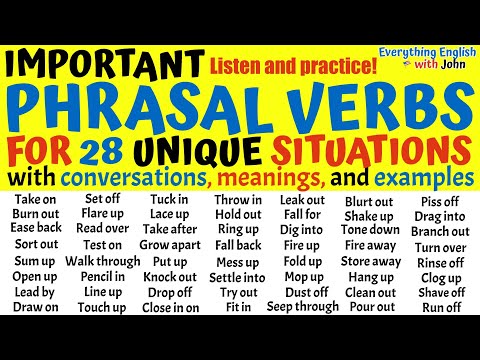
Important Phrasal Verbs for 28 Unique Situations – Become Fluent in Almost Any Situation
Phrasal verbs grouped into 28 specific situations, including habits, work-life balance, studying, shopping, family, and vacations.

Use These 22 Phrasal Verbs to Sound More Natural
22 conversational phrasal verbs explained one by one, including nod off, pig out, cut out, opt out, chicken out, egg on, come up with, chip in, come across, look down on, write off, and cozy up to.

MASTER 50 Important English Expressions for Complaining to Be Fluent in English
50 common English expressions for complaining politely and effectively in everyday conversation, each explained with an example.

MASTER Every Way to Use Common English Verbs: GET, GO, TAKE, MAKE, DO and More
A deep dive into every common phrasal-verb use of get, take, do, make, tell, run, let, meet, and go.

MASTER 50 Important English Expressions for Agreeing and Disagreeing to Be Fluent in English
50 English expressions for agreeing and disagreeing in natural conversation, each explained with an example sentence.

MASTER the Verb BE | Speak English Like a Native Speaker Fast
“Be” is one of the most important verbs in English, used to describe identity, states, and existence: am, is, are, was, were.
Phrasal Verb Secrets!

Use THIS Phrasal Verb When you Have Choices + 6 Phrasal Verbs with Down
A quiz-style lesson revealing the phrasal verb for talking about choices, plus six more phrasal verbs that use “down.”

Use THIS Phrasal Verb for Iran’s Nuclear Program
A current-events lesson that reveals a phrasal verb through a real news story about Iran’s nuclear program.

Use THIS Phrasal Verb When You’re ANGRY! – Phrasal Verbs with Out
A quiz-style lesson revealing a phrasal verb for talking about anger, plus more phrasal verbs that use “out.”

Can You Identify These Phrasal Verbs with Back?
A quiz challenging you to identify several phrasal verbs that use “back,” each explained afterward.
Use THIS Phrasal Verb to Get Things Done!
A quiz-style lesson revealing a phrasal verb used to talk about getting things done.

Remembering Pope Francis – How to Use Phrasal Verbs with Pass
Phrasal verbs that use “pass,” taught through a news story about Pope Francis.

How to Use Phrasal Verbs with Hang – Master Phrasal Verbs
Several phrasal verbs that use “hang,” such as hang out and hang on, each explained with examples.

How to Use Phrasal Verbs with Turn – Mastering Phrasal Verbs
Several phrasal verbs that use “turn,” such as turn up, turn down, and turn out, each explained with examples.

Ukraine’s most IMPORTANT phrasal verb!
A current-events lesson that reveals an important phrasal verb through a real news story about Ukraine.

DRONE Is a VERB?
A news-based lesson showing how “drone” is used as a verb, plus related phrasal verbs with “on.”

To Sit Up and To Stand Down: Phrasal Verb Secrets in English
“Sit up” means to rise into a sitting position or stay awake later than usual, and “stand down” means to step back from a position of duty, alert, or conflict.
To Get Myself Up: Phrasal Verb Secrets in English – Phrasal Verbs with Get
“Get (myself) up” means to get out of bed or push yourself into motion, especially when it is hard to start the day.

To Tone Down: Phrasal Verb Secrets in English – Election Vocabulary! – Phrasal Verbs with Down
“Tone down” means to make something less extreme, intense, or offensive.

Weigh in on: Phrasal Verb Secrets in English – Election Vocabulary! – Phrasal Verbs with On
“Weigh in on” means to give your opinion about something, taught here through election-themed vocabulary.

To Give Out: How to Use Phrasal Verbs, Learn English Phrasal Verbs
“Give out” means to hand something out to a group of people, or to stop working because of exhaustion.

To Blow Over: How to Use Phrasal Verbs, Learn English Phrasal Verbs
“Blow over” means for a problem, storm, or argument to pass without serious, lasting consequences.

Phrasal Verbs with Out – To Black Out – Vocabulary
“Black out” means to lose consciousness, or to lose electrical power.

Animal Phrasal Verbs – To Tell On, To Rat on, Animal Vocabulary
Both “tell on” and “rat on” mean to inform someone in authority about another person’s wrongdoing, explained here with animal-themed examples.

Phrasal Verbs with Out – To Pig Out, To Bug Out
“Pig out” means to eat a large amount of food greedily, and “bug out” means to leave suddenly or panic and flee.

To Move Down + Phrasal Verbs with Down
“Move down” means to go to a lower position, rank, or level.
To Go Down As, Phrasal Verbs with Down + Quiz
“Go down as” means to be remembered or recorded in history as something.

Come Over, Go Over,, Phrasal Verbs with Over: How to Use Phrasal Verbs
“Come over” means to visit someone at their home, and “go over” means to review something or to be received in a certain way.

To Figure – Learn English Verbs – Make Phrasal Verbs!
“Figure out” means to understand or solve something after thinking about it.

Find Out or Figure Out? Learn and Practice Phrasal Verbs
“Find out” means to discover information, while “figure out” means to solve or understand something through thought. This lesson compares the two.

To Make Up – 3 Meanings with Phrasal Verb Practice
“Make up” means to invent a story, to apply cosmetics, or to reconcile after a fight, three separate meanings covered in this lesson.

To Pull Over – Sound American While Driving
“Pull over” means to move a vehicle to the side of the road and stop.

Learn The Most Misused Phrasal Verb – To Go Out
“Go out” means to leave your home for a social activity, or for a fire or light to stop burning.

A Different Way to Learn Phrasal Verbs – To Mess Up
“Mess up” means to make a mistake, or to make something messy or disorganized.

To Fool Around: How to Use Phrasal Verbs, Learn English Phrasal Verbs
“Fool around” means to behave in a playful, silly, or careless way instead of being serious.

To Help Out: How to Use Phrasal Verbs, Learn English Phrasal Verbs
“Help out” means to give someone assistance, especially when they need it.

To Blow Out: Learn Phrasal Verbs Through Stories
“Blow out” means to put out a flame by blowing air on it.

To Ring In: Learn Phrasal Verbs Through Stories
“Ring in” means to celebrate the start of something, like a new year.

To Call In (Sick): Learn Phrasal Verbs Through Stories
“Call in” means to phone your workplace to say you cannot come in, often because you are sick.
To Make Up: Learn Phrasal Verbs Through Stories, English Practice Time
“Make up” means to invent a story, to apply cosmetics, or to become friends again after an argument.

To Stress Out: Learn Phrasal Verbs Through Stories, English Practice Time
“Stress out” means to feel, or to make someone feel, worried and anxious.
To Burst Out: Learn Phrasal Verbs Through Stories, English Practice Time
“Burst out” means to suddenly start doing something, like laughing or crying.

To Talk Down To: Learn Phrasal Verbs Through Stories, English Practice Time
“Talk down to” means to speak to someone as if they are less intelligent or important than you.

To Wear Out: Learn Phrasal Verbs Through Stories, English Practice Time
“Wear out” means to become damaged or unusable from extended use, or to exhaust someone.

To Wipe Off: Learn Phrasal Verbs Through Stories, English Practice Time
“Wipe off” means to remove something from a surface by wiping it.

To Branch Out: Learn Phrasal Verbs Through Stories, English Practice Time
“Branch out” means to expand your activities or interests beyond what you usually do.

To Roll Out: Learn Phrasal Verbs Through Stories, English Practice Time
“Roll out” means to officially launch or introduce a new product, service, or plan.
To Bring Up: Phrasal Verbs in English Conversation #phrasalverbs
“Bring up” means to mention a topic in conversation, or to raise a child.

To Eat Up: Phrasal Verbs in English Conversation #phrasalverbs
“Eat up” means to eat all of something completely, or to use up a large amount of time or resources.

To Fight Back: Phrasal Verbs in English Conversation #phrasalverbs
“Fight back” means to defend yourself against an attack, criticism, or difficulty.

Using On in Phrasal Verbs – Phrasal Verbs in English
“Live on” means to survive on a certain amount of money or food, taught through three short stories plus a quiz on other phrasal verbs with “on.”

To Live On: How to Use Phrasal Verbs, Learn English Phrasal Verbs
“Live on” means to survive using a certain amount of money or food, or to continue existing after death, like a memory.

To Fade Away: Phrasal Verbs in English Conversation #phrasalverbs
“Fade away” means to gradually disappear or become weaker.
To Pal Around: Phrasal Verbs in English Conversation #phrasalverbs
“Pal around” means to spend time with someone as a casual friend.

Phrasal Verbs with Up and Down: How to Use Phrasal Verbs, Learn English
Phrasal verbs that use “up” and “down,” taught through a short story.

To Burn Out: Phrasal Verbs in English Conversation #phrasalverbs
“Burn out” means to become exhausted from prolonged overwork or stress.

To Cut Up: Phrasal Verbs in English Conversation #phrasalverbs
“Cut up” means to cut something into smaller pieces.

To Shrug Off: Phrasal Verbs in English Conversation #phrasalverbs
“Shrug off” means to treat something as unimportant and not let it bother you.
To Pull Through: Phrasal Verbs in English Conversation #phrasalverbs
“Pull through” means to survive a difficult situation, like a serious illness.

Understanding the Verb: Take Off – Learn English, Phrasal Verbs
“Take off” means for a plane to leave the ground, to remove clothing, or to suddenly become successful.

To Gobble Up: Phrasal Verbs in English Conversation #phrasalverbs
“Gobble up” means to eat something very quickly and eagerly.

To Peel Off: Phrasal Verbs in English Conversation #phrasalverbs
“Peel off” means to remove a thin outer layer from something.

To Hook On: Phrasal Verbs in English Conversation #phrasalverbs
“Hook on” means to become interested in or attached to something.

To Get Along with: Phrasal Verbs in English Conversation #phrasalverbs
“Get along with” means to have a friendly relationship with someone.
To Come Out: Phrasal Verbs in English Conversation #phrasalverbs
“Come out” means to become known publicly, or to be released, like a movie or new product.

To Brush Off: Learn Phrasal Verbs Through Stories, English Practice Time
“Brush off” means to dismiss or ignore someone or something.

To Freak Out: Phrasal Verbs in English Conversation #phrasalverbs
“Freak out” means to become extremely worried, scared, or excited.

To Dumb Down: Phrasal Verbs in English Conversation #phrasalverbs
“Dumb down” means to make something simpler or less intellectually demanding than it should be.

To Hold Over: Phrasal Verbs in English Conversation #phrasalverbs
“Hold over” means to keep or postpone something until a later time.

To Shout Out: Learn Phrasal Verbs Through Stories, English Practice Time
“Shout out” means to publicly acknowledge or thank someone.

To Catch Up: Learn Phrasal Verbs Through Stories, English Practice Time
“Catch up” means to reach the same level as someone else, or to update someone on recent news.

To Geek Out: Learn Phrasal Verbs Through Stories, English Practice Time
“Geek out” means to become very enthusiastic and talk in detail about a topic you love.

To Kick Back: Learn Phrasal Verbs Through Stories, English Practice Time
“Kick back” means to relax.

To Double Down: Learn Phrasal Verbs Through Stories, English Practice Time
“Double down” means to become more committed to a decision or position, especially a risky one.

To Put Up With: Learn Phrasal Verbs Through Stories, English Practice Time
“Put up with” means to tolerate something unpleasant without complaining.
To Get Over: Learn Phrasal Verbs Through Stories, English Practice Time
“Get over” means to recover from something difficult, like an illness or heartbreak.

To Tire Out: Learn Phrasal Verbs Through Stories, English Practice Time
“Tire out” means to make someone very tired.

To Cozy Up To: Learn Phrasal Verbs Through Stories, English Practice Time
“Cozy up to” means to try to become friendly with someone, often for personal benefit.

To Push Back: Learn Phrasal Verbs Through Stories, English Practice Time
“Push back” means to resist or oppose something, or to delay it.

To Lean On: Learn Phrasal Verbs Through Stories, English Practice Time
“Lean on” means to rely on someone for support, or to pressure someone.

To Write Off: Learn Phrasal Verbs Through Stories, English Practice Time
“Write off” means to dismiss something as unimportant or a failure, or to cancel a debt.

To Leave Out: Learn Phrasal Verbs Through Stories, English Practice Time
“Leave out” means to not include something or someone.

To Monkey Around: Learn Phrasal Verbs Through Stories, English Practice Time
“Monkey around” means to behave playfully or waste time instead of being productive.

To Pay Off: Learn Phrasal Verbs Through Stories, English Practice Time
“Pay off” means to be worth the effort, or to fully repay a debt.

To Look Down On: Learn Phrasal Verbs Through Stories, English Practice Time
“Look down on” means to think you are better than someone else.

To Come Across: How to Use Phrasal Verbs, Learn English Phrasal Verbs
“Come across” means to give a particular impression, or to find something by chance.

To Chip In: Learn Phrasal Verbs Through Stories, English Practice Time
“Chip in” means to contribute money, help, or ideas toward something.

To Cave In: Learn Phrasal Verbs Through Stories, English Practice Time
“Cave in” means to give in to pressure, or to physically collapse.

To Come Up With: Learn Phrasal Verbs Through Stories, English Practice Time
“Come up with” means to think of an idea or plan.

To Dress Up: Learn Phrasal Verbs Through Stories, English Practice Time
“Dress up” means to wear formal or special clothes, or to wear a costume.

To Slack Off: Learn Phrasal Verbs Through Stories, English Practice Time
“Slack off” means to stop working hard or put in less effort than usual.

To Give Up: Learn Phrasal Verbs Through Stories, English Practice Time
“Give up” means to stop trying, or to quit something.

To Egg Someone On: Learn Phrasal Verbs Through Stories, English Practice Time
“Egg someone on” means to encourage someone to do something, often risky or unwise.

To Rope In: Learn Phrasal Verbs Through Stories, English Practice Time
“Rope in” means to persuade someone to take part in something.
To Chicken Out: Learn Phrasal Verbs Through Stories, English Practice Time
“Chicken out” means to decide not to do something because you are scared.

To Opt Out: Learn Phrasal Verbs Through Stories, English Practice Time
“Opt out” means to choose not to take part in something.

To Scoot Over: How to Use Phrasal Verbs, Learn English Phrasal Verbs
A focused mini-lesson on the phrasal verb “scoot over,” covering its meaning and how to use it naturally in conversation.

To Cut Out: Learn Phrasal Verbs Through Stories, English Practice Time
“Cut out” means to remove something, or to stop doing something.

To Pig Out: How to Use Phrasal Verbs, Learn English Phrasal Verbs
“Pig out” means to eat a large amount of food greedily.

To Nod Off: How to Use Phrasal Verbs, Learn English Phrasal Verbs
“Nod off” means to fall asleep, usually unintentionally.